

Let’s Break This Shot Down
Come behind the scenes as I break down how I map out coverage, visuals, and intention before a shoot

Alright Y’all.
It’s Caroline. And I feel like I should start this week with a bit of self-awareness.
I was originally going to open this by saying something vulnerable about how I’m going to show you my very bad, very messy storyboards. Like, really lower your expectations. Stick figures. Questionable spatial logic. The whole thing. But then I remembered that Rian Johnson’s storyboard for Knives Out looks… like this:
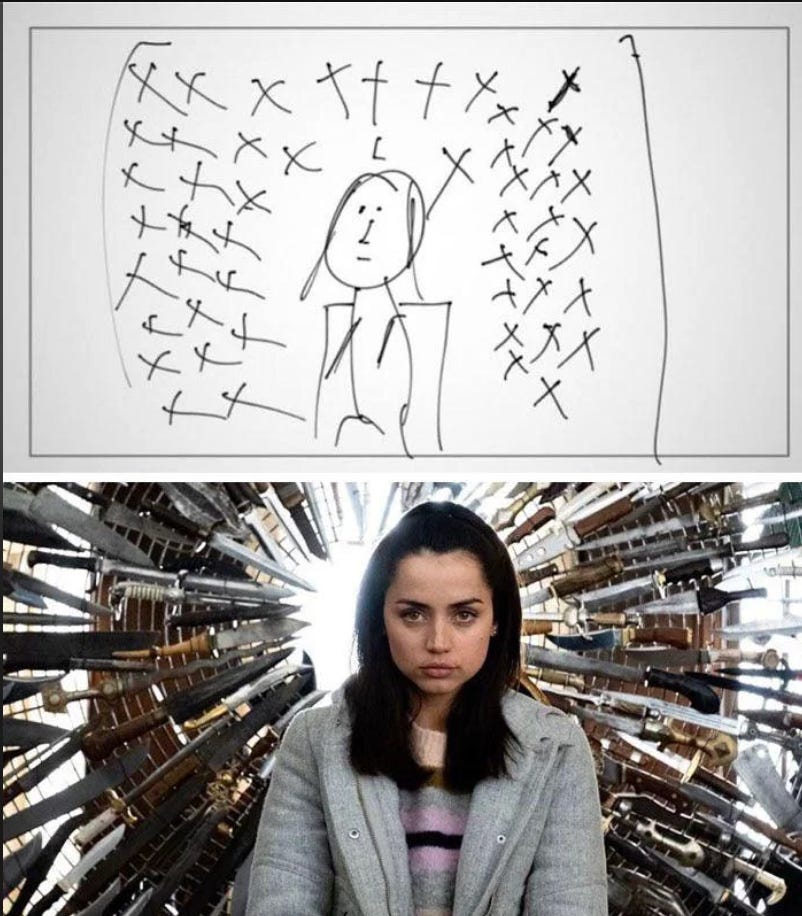
So honestly. Fuck it.
If you’ve been following along, a lot of the brand I’ve built around myself (and Final Girl as an extension of that) is rooted in this idea that I can think on my feet. That I can show up with limited resources, pivot when things inevitably fall apart, and still walk away with something that feels intentional and, hopefully, beautiful. Scrappy has kind of been the name of the game (so much-so that I wouldn’t blame you if you read this, rolled your eyes, and went “okay we GET IT!!”)
All of that is still true. But I’m actually really excited this week to do the opposite.
Because thanks to our lovely, incredible friend and frequent collaborator Audrey Shapiro, we have the opportunity to shoot in a gorgeous Manhattan skyrise office space that’s been featured in huge mainstream shows like American Horror Story. And beyond that, I was able to go on a proper tech scout ahead of time, which in indie filmmaking terms feels luxurious.
Having access to the space before we shoot has completely shifted how I’m approaching this. Instead of showing up and figuring it out as we go, I get to slow down and come in with a whole level of intention that we don’t always have the time or resources for. I get to think about how the scene actually lives in the space, how the light behaves, where the camera wants to be before we’re under pressure to make a hundred decisions at once.
And to be honest, I’m hungry for that.
So I thought I’d walk you through how I’m approaching one of the first moments we’ll be shooting in this location: the opening scene that establishes Emmy’s world in New York City.
This scene comes directly after our initial flashback sequence of the slashings, which we shot with a lot of warmth. Tungsten lighting, rich tones, a kind of almost suffocating atmosphere, and of course… blood. It feels chaotic and visceral and a little unhinged. So cutting from that into this office, I want the contrast to be immediate, almost jarring. Actually scratch that — I want it to be as jarring as possible. Cold. Clinical. Controlled. A space that feels almost too clean, like the emotional temperature has been completely drained out of the room.
That shift isn’t just something I’m thinking about in theory. It’s something I’m trying to build into the actual shot design from the very beginning.
This first shot I want is going to start out as an extreme close-up on Emmy, asleep with her head down on her desk. We slowly dolly out over the low hum of an office environment, the kind of ambient noise that feels almost too clean to be comforting. Printers, distant chatter, the soft buzz of fluorescent lights. As we pull back, the frame keeps opening until we land in an extreme wide just as she snaps awake. Disoriented. Not entirely sure where she is. And honestly, neither are we. Was that initial flashback something that actually happened, or are we coming out of a dream? At this point, we don’t know yet. We’re still at the very beginning.
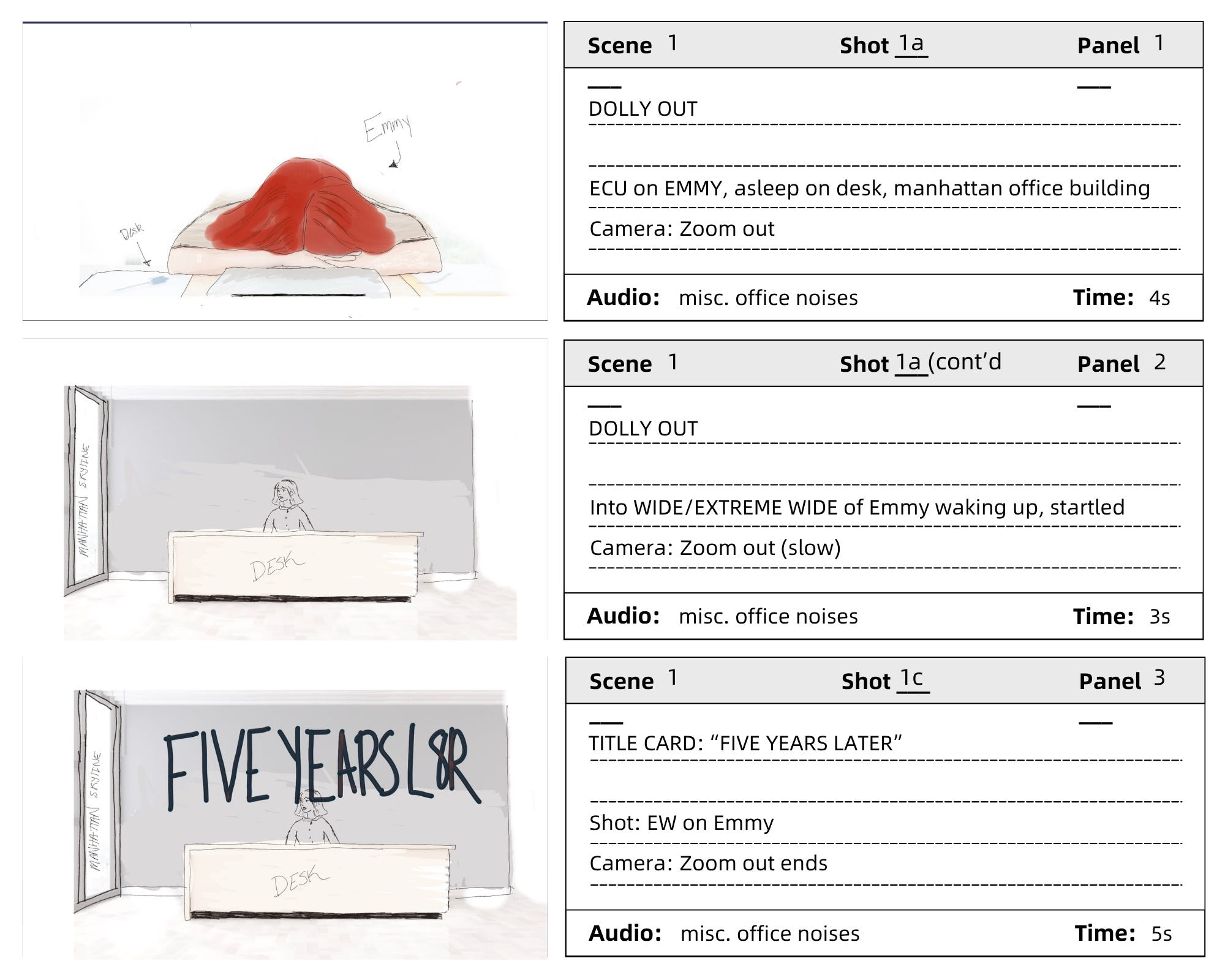
I drew this rough storyboard using Procreate on my iPad, which has become my go-to for getting ideas out of my head quickly. When it comes to finding inspiration for shots and angles, I use ShotDeck. I pay for the subscription (it’s about $13 a month) and I genuinely use it enough to justify it. Being able to search for specific moods, lighting styles, or compositions and see how other filmmakers have approached similar moments is incredibly helpful when I’m trying to articulate something that still feels a little abstract in my head.
Shotdeck is a tool I recently got the students at the center of a documentary I’m working on to use as a visual reference because it is simply that good. You can use its database to source so many different types of shots, lens types, number of subjects in frame, and even by color palette - so you can also use color theory to create a jarring juxtaposition between timelines!
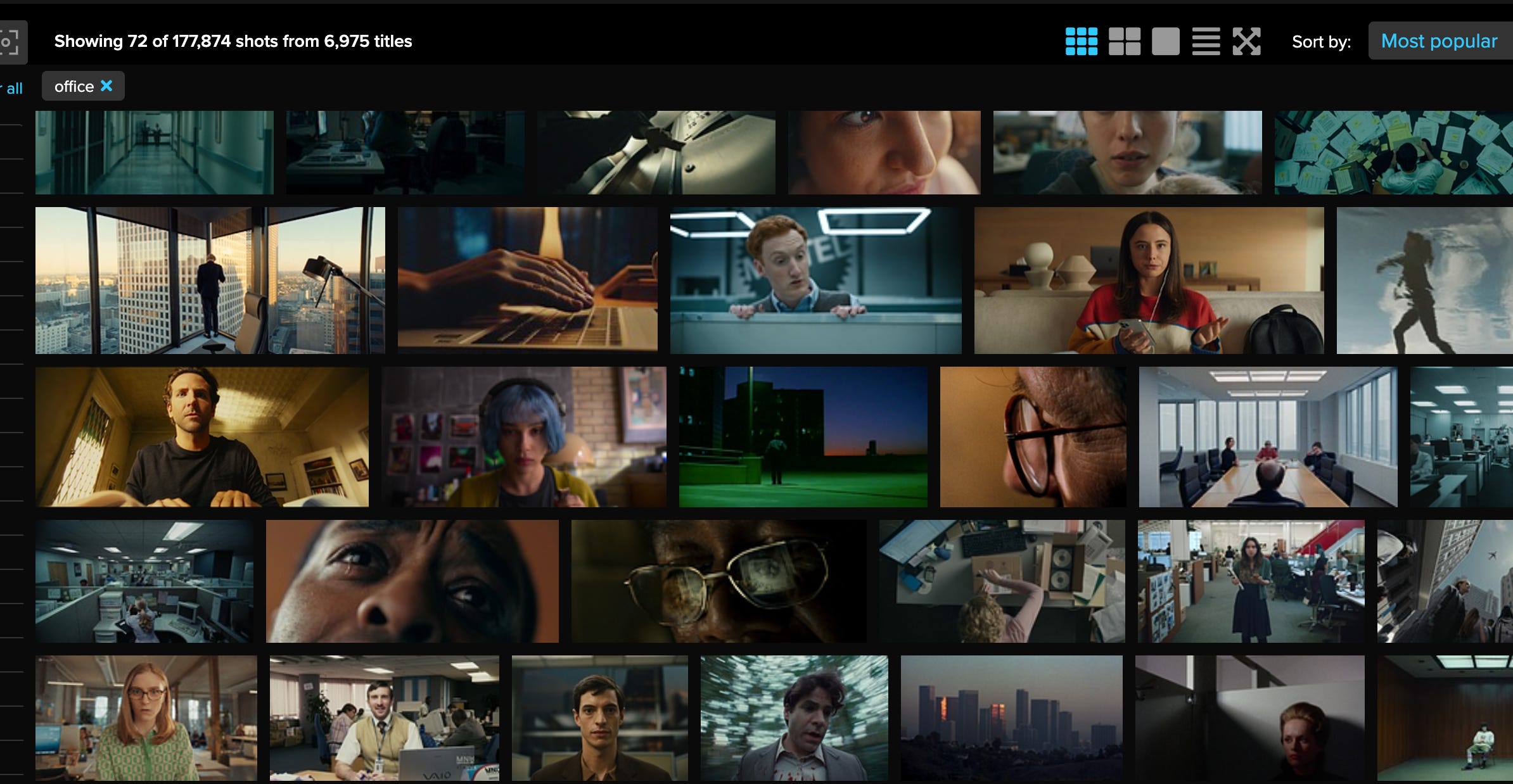
just look at how much amazing inspiration popped up by just looking up “office”! I love it!
I’ve written in the past about how one of the best ways to learn how to shot-list is by dissecting scenes you love. Taking a sequence from a film and breaking it down shot-by-shot, figuring out why each cut happens when it does, what information is being revealed, and how the camera is guiding your attention. It’s one thing to watch something and think it feels good. It’s another to actually understand why.
Once I’ve sketched out the initial shots that are floating around in my brain, I’ll upload everything into Canva and drop them into a simple storyboarding template. It doesn’t need to be fancy. It just needs to be clear enough that I can share it with my DP, Emily, and anyone else who needs a visual reference for what I’m thinking. Half the battle is just getting everyone aligned before we even step on set.
(psst: don’t be afraid to take liberties with your storyboards! They’re not supposed to look amazing. All that matters is you have a reference for your vision to show on the fly!)
Admittedly, I haven’t always had the luxury of sitting down and storyboarding something this thoroughly. And as much as I genuinely love the scrappy, figure-it-out-as-you-go energy of indie filmmaking, there is something incredibly exciting about slowing down and actually planning. About knowing that when we walk into this location, I’m not immediately racing against a clock or trying to solve everything in real time.
This time, I get to be methodical. I get to make choices ahead of time and then refine them instead of inventing them on the spot. And there’s a kind of relief in that. A sense that I might actually be able to deliver the cleanest, most intentional version of what I’ve been seeing in my head all along.
We’ll see if I can keep that energy once we’re actually racing the clock next month!
Xoxo,
Caroline :)