

The Night Horror Won
The Oscars finally caught up! And Sinners is already changing what filmmakers can demand next.

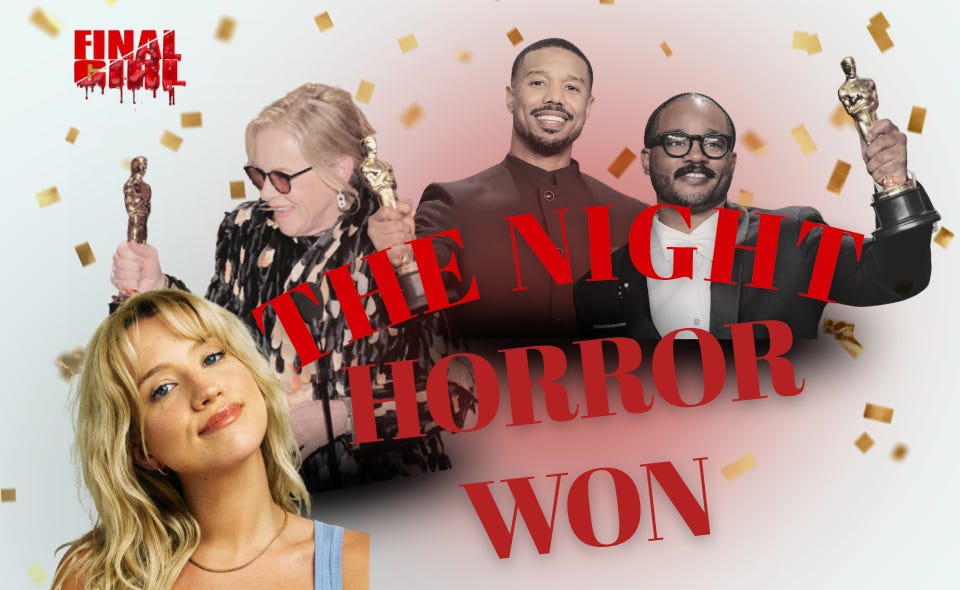
Hello Leorah here it’s actually CAROLINE this week!! What a plot twist!
I wasn’t planning on taking over Substack duties again this week, but as I watched the Oscars unfold on Sunday night, the sheer number of victories for horror made it impossible not to. I felt compelled to jump back in just to say, plainly and without hesitation… I was right.

Honestly there’s something almost disorienting about writing this after spending so much time yelling into the void about it (in a good way, I swear!!), but horror finally had its night at the Oscars! And I don’t mean in the usual way, where the Academy throws the genre a nomination or two every decade like a polite acknowledgment before returning to business as usual. I mean in a way that actually forces a re-evaluation of what kinds of films are allowed to be taken seriously. Because if you read my piece from last year, Oh, the Horror!, then you already know this has been a long time coming. For decades, the Academy has treated horror like it doesn’t exist, or worse, like it only counts when it can be repackaged into something more palatable, more respectable, more easily categorized as “important.” That pattern is so consistent it has become part of the genre’s identity, with some of the most iconic performances and films being dismissed in real time only to be retroactively labeled as “robbed” once it is safe to admit they mattered.
Which is why this year feels so seismic. Sinners did not just perform well, it rewrote the rules, made all the more significant by the fact that it is a deeply Black narrative, engaging directly with the legacy of segregation, the complexities of post-emancipation race relations, and the enduring influence of Southern Baptist ideology across the Antebellum South (If you remember the #OscarsSoWhite controversies a few years ago, you’ll know exactly why this feels like such an amazing step in the right direction). That impact extended beyond the story itself and into the history books, with the film’s cinematographer becoming the first woman, and notably the first woman of color, to ever win the Academy Award for Best Cinematography, marking a long-overdue breakthrough in one of the industry’s most historically exclusionary categories.
With sixteen nominations, the most for any film in Oscar history, it forced the Academy into a position where ignoring horror was no longer an option. And yes, it only walked away with four wins, but even that framing feels reductive, because the nominations themselves are the story if you ask me! They are the thing I have been arguing for, the thing I wrote Oh, the Horror! about in the first place, that recognition is the first barrier, that visibility is the prerequisite for any kind of legitimacy within these institutions. You cannot win if you are not even considered, and for so long horror has not been.
What makes this year even more undeniable is that the shift did not stop at Best Picture conversations or technical categories, the places where the Academy has historically felt safest rewarding genre work. It cracked open the acting categories, which are arguably the most protected, the most tied to legacy and prestige. Michael B. Jordan winning Best Actor for a horror performance does not just feel like a win, it feels like a correction. Amy Madigan taking Supporting Actress for a horror performance further cements that this is not a fluke or a one-off anomaly. Two out of four acting awards going to horror is something that would have felt almost impossible even a few years ago, especially when you consider how many performances we have collectively had to argue into legitimacy after the fact. If you follow trends within the industry, you know exactly how rare this is, how many times horror has been shut out of these categories entirely, how often it has had to contort itself into something else just to be acknowledged.
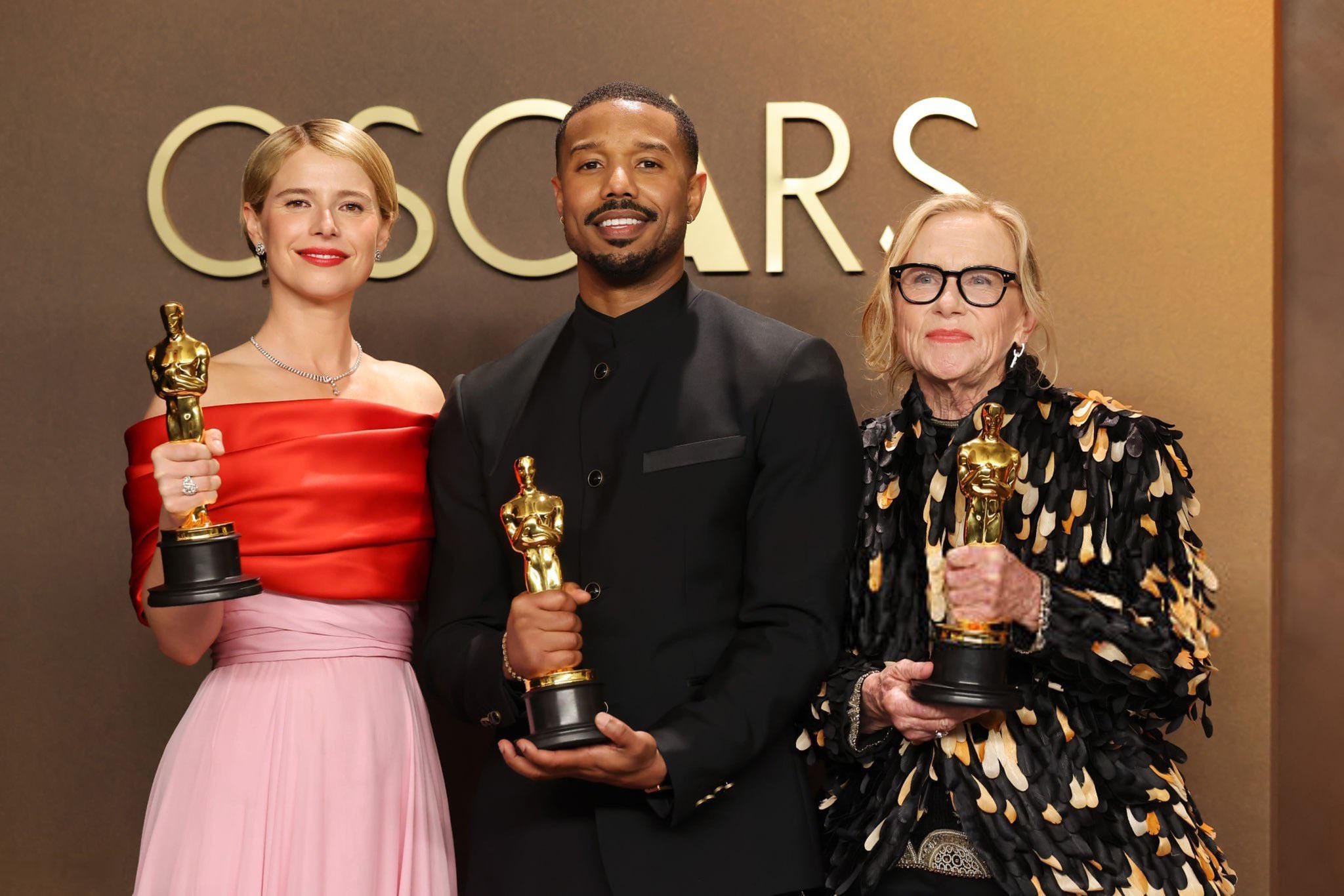
And even in the categories where horror did not win, it still dominated the conversation. I was personally rooting for Wunmi Mosaku for Supporting Actress, and while she did not take home the award, the fact that two of the strongest contenders in that category came from horror performances says everything about where we are right now. Because historically, that is not even a conversation we get to have. The genre has so often been excluded at the starting line that it rarely gets the chance to compete, let alone define the race!
But what makes Sinners feel like more than just an awards moment, more than just a long-overdue acknowledgment, is that the shift was not only happening on screen. It was happening behind the scenes, in a way that might ultimately have an even longer-lasting impact on the industry as a whole if I do say so myself. While everyone was focused on the nominations, the performances, the wins, Ryan Coogler was negotiating something that quietly challenges the entire structure of how films are made and owned. In making Sinners, he secured a deal that includes final cut, first-dollar gross participation, and most significantly, full ownership of the film after twenty-five years. That last part is the kind of detail that might sound small to anyone outside the industry, but it fundamentally disrupts the way Hollywood has operated for decades. Studios do not just finance and distribute films, they build libraries, they rely on the long-term ownership of those films as the backbone of their business model. The idea that a filmmaker could eventually reclaim ownership of a major studio film is not just rare, it is almost unheard of, which is exactly why it has been described as something that could recalibrate expectations and unsettle the existing balance of power between studios and creators.
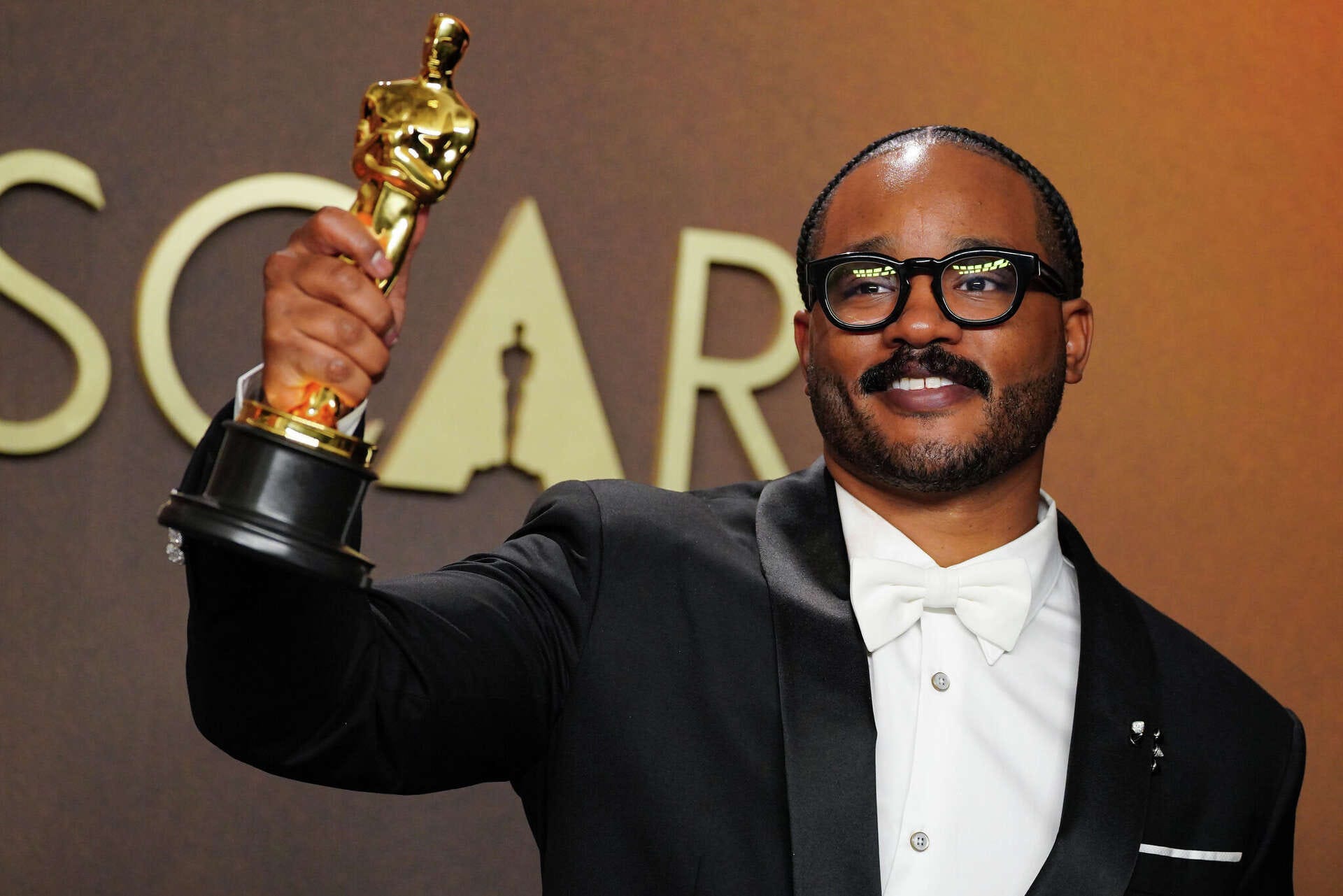
And it raises a very simple but very loaded question, which is dangerous for who. Because from a creative standpoint, it feels less like a risk and more like a long overdue correction. For so long, filmmakers, especially those working in genre and especially those telling culturally specific stories, have been expected to trade ownership for opportunity. The unspoken agreement has always been that you can tell your story, but it will not fully belong to you. And Sinners quietly rejects that framework. What makes it even more compelling is how aligned this is with the film itself, a story deeply rooted in legacy, culture, and ownership, now mirrored by the way it exists in the world. It is one of those rare moments where the art and the business of the art are in direct conversation with each other, where the themes of the film extend beyond the screen and into the conditions under which it was made.
That is why it feels so much bigger than a single Oscars season, or even a single film. Because if this deal becomes precedent, or even just possibility, it changes what filmmakers can ask for, what they can expect, what they can imagine for themselves long term. It challenges the idea that recognition has to come at the cost of control, that success within the system requires complete submission to it. And in a way, that makes this entire moment feel like it exists on two parallel tracks. On one hand, horror is finally being taken seriously on screen, recognized not as a novelty or an exception but as a legitimate and powerful form of storytelling. On the other, a filmmaker working within that space is quietly expanding what is possible off screen, pushing against the boundaries of ownership and authorship in an industry that has historically been very resistant to both.
I think that is why this year feels different, and why it feels important to hold both the excitement and the context at the same time. Because as much as I want to celebrate this moment, Oh, the Horror! still stands. One historic year does not undo decades of dismissal, it does not retroactively fix the performances that were ignored or the films that were never given the same weight. But it does suggest that something is shifting, not just in what gets recognized, but in who gets to hold onto the work once it is. And for the first time in a long time, it feels like we are not just asking to be let in. It feels like we are starting to redefine the terms entirely.